
Decoding the Spiral: The Hidden Math of Sunflowers
Source: https://mathevedic.substack.com/p/decoding-the-spiral-the-hidden-math-of-sunflowers
Here is the simple, beautiful breakdown of how it works.
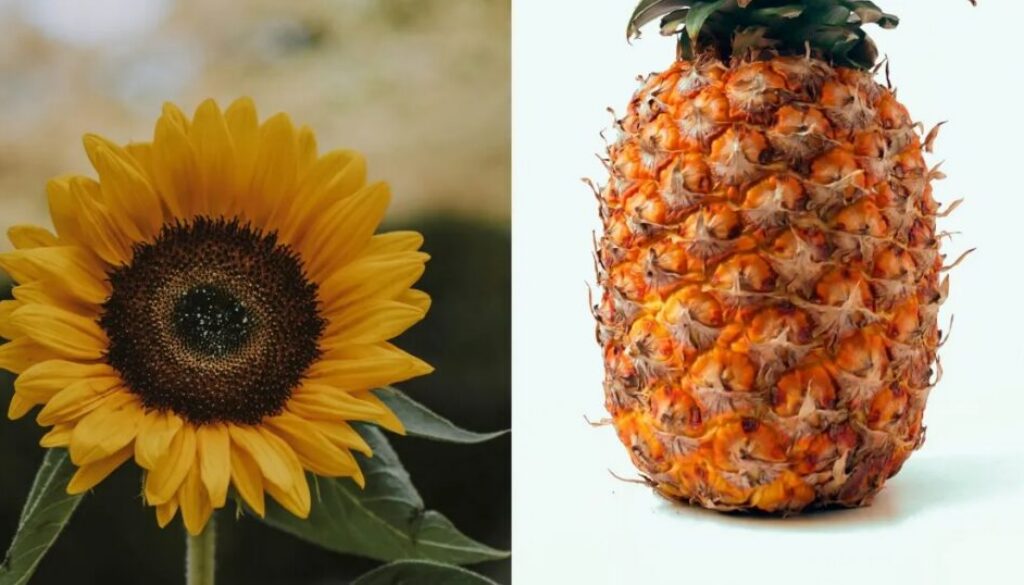
First, look at a sunflower. It is not just a grid, but a dense matrix of intersecting spirals, some winding clockwise, others counter-clockwise.
If you sit down and manually count those spirals, something incredible happens. You will almost always hit two numbers from the Fibonacci sequence (1, 2, 3, 5, 8, 13, 21, 34, 55, 89…).
For those who don’t know; the Fibonacci sequence is a fascinating pattern where every number is the exact sum of the two numbers that came before it. It starts with 0 and 1 and then continues.
For example: Sunflowers usually have 34 spirals curving one way and 55 the other. Large ones hit 55 and 89. Pinecones typically have 8 and 13 spirals whereas pineapples usually have 8, 13, or 21 spirals.
Plants don’t have brains, and they don’t know arithmetic. This geometry is entirely driven by physics and growth hormones.
At the absolute tip of a growing stem is a tiny generator called the meristem. As the stem grows upward, it periodically spits out a tiny bump of cells called a primordium. Each bump eventually grows into a leaf, a seed, or a petal.
When a new bud forms, it pushes away from the centre. The stem then rotates a specific amount before spitting out the next one.
To maximize space, the plant needs an angle of rotation that ensures no two leaves or seeds directly block each other.
Imagine if a plant rotated by a simple fraction of a circle, say exactly 90 degrees (1/4 of a full turn).
The first bud pops out. The stem turns 90 degrees, and pops out the second. By the time it spits out the fifth bud, it has completed a full loop. The fifth bud lands directly on top of the first one.
If this happened, the leaves would grow in four straight lines like spokes in a bicycle wheel. Huge gaps of empty space would be left between the rows, and the top leaves would completely block the bottom leaves from getting sunlight.
To avoid this, nature uses the most stubborn, un-fractional angle possible, that is 137.5 degrees, known as the Golden Angle.
(Where Φ is the Golden Ratio, roughly equal to 1.618).
Because this angle is based on the Golden Ratio, it can never be turned into a clean fraction. This means the plant’s rotation never “repeats” a position. Every single new seed or leaf lands in a slightly offset, perfect gap between the older ones.
This provides two massive evolutionary advantages:
First is the ultimate packing hack. Seeds nestle into the gaps of the previous seeds with zero wasted space. It is the absolute mathematical limit for packing density. A sunflower can cram hundreds of seeds into its head without a millimetre of wasted real estate.
Secondly, it is the canopy trick. For leafy plants, this spiral staircase pattern means that as leaves stack up the stem, each leaf gets its own unobstructed vertical window to catch sunlight and funnel rain down to the roots.
So, how do we get back to the Fibonacci numbers we counted earlier? They are a mathematical byproduct of the packing.
Because the seeds are tightly packed using this 137.5° offset, your eyes naturally track lines between the seeds that are closest to each other. Because of the geometry of the Golden Ratio, the number of spirals you see must always add up to consecutive Fibonacci numbers.
Nature didn’t sit down and write code. Through millions of years of trial and error, the plants that mutated closest to this perfect angle packed more seeds, absorbed more light, and out-survived the rest.
Next time you’re cutting up a pineapple, take a second to look at the scales. You’re looking at a physical, living optimization algorithm.