
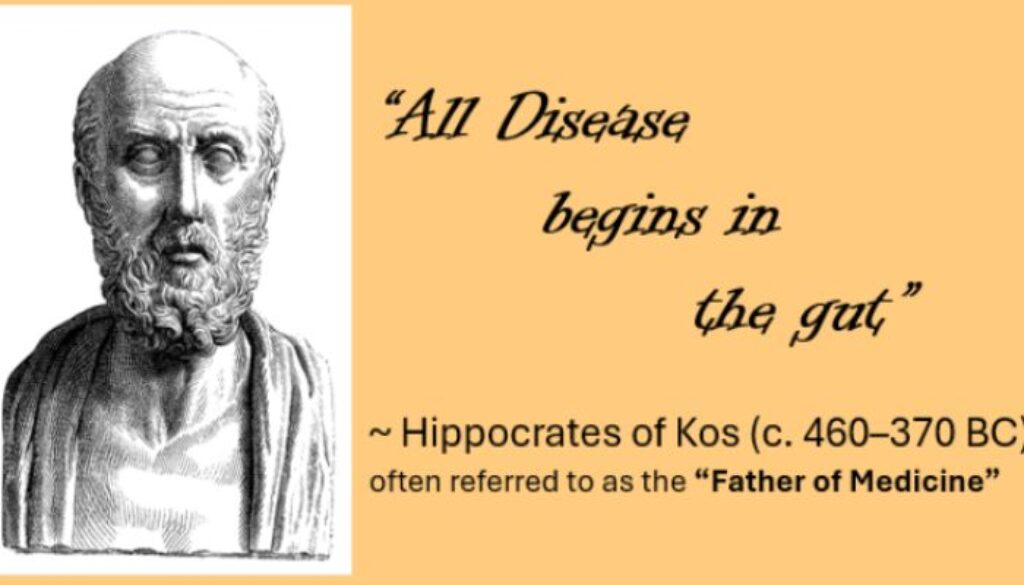
“All Disease Begins in the Gut” Ancient Wisdom Meets Modern Science
Source: Patrick W. (Bill) Frank, DC
Nearly 2,500 years ago, the ancient Greek physician Hippocrates famously declared, “All disease begins in the gut.” While not all diseases originate in the digestive system, modern biomedical research increasingly supports the idea that gut health plays a central, systemic role in human disease and wellness [2].
The Gut: Foundation of Whole-Body Health
The digestive system is now recognized as a complex, interactive organ system, housing trillions of microorganisms collectively known as the gut microbiome. These microbes participate in digestion, vitamin synthesis, immune development, metabolic regulation, and neurochemical signaling [2].
Disruptions in this ecosystem – commonly referred to as dysbiosis – have been linked to a wide range of chronic diseases, including:
- Cardiovascular disease
- Obesity and metabolic syndrome
- Type 2 diabetes
- Autoimmune and inflammatory diseases
- Certain cancers
- Respiratory disease
- Neurological and psychiatric disorders
Large-scale reviews demonstrate that the gut microbiome acts as a key mediator between diet, environment, and disease risk, influencing systemic inflammation and immune function far beyond the gastrointestinal tract [2].
What Modern Research Tells Us
1. The Microbiome Has System-Wide Effects
Modern microbiome research confirms that gut microbes influence host physiology at multiple levels, including immune signaling, lipid metabolism, glucose regulation, and inflammatory pathways [2]. Rather than acting locally, microbial metabolites circulate throughout the body, affecting distant organs such as the heart, brain, liver, and lungs [1].
This systemic influence helps explain why gut dysbiosis is associated with diverse disease states that appear unrelated to digestion.
2. Specific Microbes Are Linked to Health and Disease
A landmark 2025 Nature study analyzed gut microbiome data from over 34,000 individuals in the U.S. and U.K., identifying microbial species consistently associated with favorable or unfavorable health outcomes [1]. The study demonstrated that:
- Certain microbial taxa correlate with lower BMI, improved lipid profiles, better glycemic control, and reduced inflammation [1].
- Other microbes are strongly associated with obesity, insulin resistance, and cardiometabolic risk [1].
- Dietary interventions can meaningfully shift microbiome composition toward a healthier profile over time [1].
These findings provide direct evidence that diet-driven changes in the microbiome can influence disease risk, reinforcing Hippocrates’ emphasis on nutrition and digestion.
3. Gut Barrier Integrity and Chronic Inflammation
Dysbiosis can impair the intestinal barrier, increasing permeability and allowing microbial products to enter circulation – a process linked to chronic low-grade inflammation, a unifying mechanism in many modern diseases [2]. This inflammatory state contributes to immune dysfunction, autoimmunity, metabolic disease, and cardiovascular pathology [2].
4. The Gut–Brain Axis and Mental Health
Emerging research shows that gut microbes communicate with the nervous system via microbial metabolites, immune mediators, and neural pathways. Altered microbiome composition has been associated with anxiety, depression, neurodegenerative diseases, and cognitive dysfunction, highlighting the gut’s role in mental and neurological health [2].
Advanced computational and AI-based approaches are now accelerating discoveries in this field, enabling researchers to model complex host–microbe interactions and predict disease associations at unprecedented scale [3].
Revisiting Hippocrates’ Insight
While it is no longer accurate to claim that all disease begins in the gut, modern research clearly supports a more nuanced interpretation: many chronic diseases are influenced—or even driven—by gut microbiome imbalance, impaired digestion, and chronic inflammation [1,2].
Hippocrates’ statement was not a literal rule, but a holistic observation about the central role of digestion, diet, and internal balance in human health. In light of contemporary microbiome science, his words feel less like ancient philosophy and more like early systems medicine.
Bibliography
- Asnicar, F., Manghi, P., Fackelmann, G., Baldanzi, G., Bakker, E., Ricci, L., Piccinno, G., Piperni, E., Mladenovic, K., Amati, F., Arrè, A., Berry, S. E., Spector, T. D., & Segata, N. (2025). Gut micro-organisms associated with health, nutrition and dietary interventions. Nature, published 10 December 2025. https://doi.org/10.1038/s41586-025-09854-7
- Zhou, T., & Zhao, F. (2025). AI-empowered human microbiome research. Gut, published online on 22 September 2025. https://doi.org/10.1136/gutjnl-2025-335946
- Sanz, Y., Cryan, J. F., Deschasaux-Tanguy, M., & et al. (2025). The gut microbiome connects nutrition and human health. Nature Reviews Gastroenterology & Hepatology, 22, 534–555. https://doi.org/10.1038/s41575-025-01077-5